
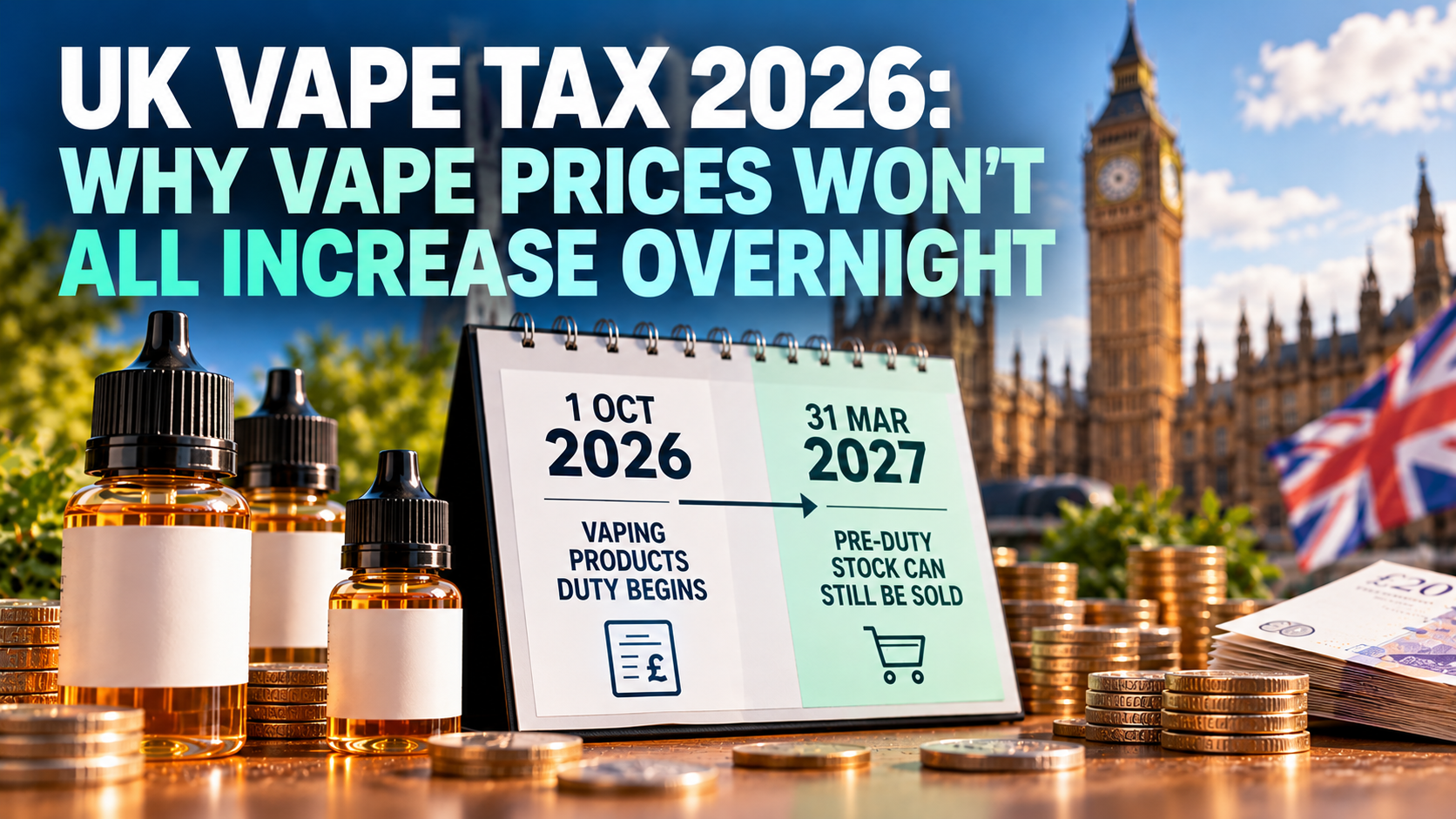
The new UK Vaping Products Duty is officially here, but that doesn't mean every vape product will suddenly cost more. Here's what's changing, why some prices may stay the same for now, and what it means for people who vape.
After months of discussion, preparation and plenty of headlines, the UK's new Vaping Products Duty (VPD) came into effect on 1st October 2026.
For many adult vapers, the biggest concern has been simple: How much more is vaping going to cost?
The good news is that the impact won't necessarily be felt all at once. Thanks to a transition period introduced by the Government, certain vaping products manufactured or imported before the new duty began can continue to be sold without the new tax until 31st March 2027.
This means prices could change gradually over the coming months rather than increasing across the board overnight.
So, what exactly has changed, and what should consumers expect?
What Is the New UK Vape Tax?
Vaping Products Duty is a new UK tax applied to vaping liquids, regardless of whether they contain nicotine.
Introduced on 1st October 2026, the duty is charged at 22p per millilitre of e-liquid, with VAT also affecting the final retail price.
For example:
- 2ml of e-liquid: £0.44p in duty
- 10ml of e-liquid: £2.20 in duty
- 30ml of e-liquid: £6.60 in duty
- 50ml of e-liquid: £11.00 in duty
These figures represent the duty itself, before any additional VAT impact or changes to retail pricing.
Importantly, the tax applies to the liquid, not the vaping device.
That means empty refillable devices, replacement coils and other hardware aren't directly subject to VPD. However, e-liquids, prefilled pods and devices supplied with vaping liquid are affected.
Why Haven't All Vape Prices Increased?
Although the new tax is already in force, the Government has introduced a six-month transition period to help retailers and suppliers adjust.
Under these arrangements, eligible vaping products that entered the supply chain before 1st October 2026 can continue to be sold without the new duty stamp until 31st March 2027.
This gives businesses time to sell through existing legitimate stock rather than replacing everything immediately.
For consumers, it means some products may remain at their previous prices while others begin reflecting the new tax.
It's also why you might notice two similar products being sold at different prices during the transition.
The difference may simply come down to when the products were manufactured, imported or released onto the market.
What Happens When Existing Stock Runs Out?
This is where consumers may begin to notice the biggest changes.
As retailers sell through their existing pre-duty stock, replacement products subject to the new tax will gradually enter the market.
Some popular products may move to duty-paid stock relatively quickly, while slower-selling products could remain at their previous prices for longer.
New products entering the market after 1st October 2026 will also need to comply with the new duty requirements.
As a result, there isn't necessarily one date when every vape product becomes more expensive.
Instead, price changes are likely to happen at different times depending on stock availability, suppliers and individual retailers.
From 1st April 2027, the transition period ends, and the new duty stamp requirements will apply across relevant vaping products offered for retail sale.
How Much More Could Vaping Cost?
The actual increase will depend on the type of product you use and how much e-liquid you purchase.
A standard 10ml bottle of e-liquid attracts £2.20 in Vaping Products Duty. Once the additional VAT impact is included, this represents a potential £2.64 increase if the full tax cost is passed on to the consumer.
For someone regularly purchasing e-liquid, those additional costs could become noticeable over time.
However, retailers ultimately determine their selling prices, so the amount consumers pay may vary.
The new duty also applies to nicotine-free e-liquids, meaning switching to a zero-nicotine liquid doesn't avoid the tax.
Could Refillable Vape Technology Become More Important?
With vaping costs changing, consumers may naturally start looking more closely at how their devices work, how much e-liquid they use and how often they need to replace components.
This is where refillable technology could become increasingly relevant.
Rather than relying on products that require a complete replacement when the liquid runs out, refillable systems are designed to allow the device to be used repeatedly.
At Refilla, we've approached this through engineering and technology.
Our refillable system combines automatic device filling with recharging, while patented ProFlow™ technology is designed to manage heat and deliver consistent performance.
The aim is to make refilling simpler, reduce unnecessary waste and offer a more convenient experience for adult users.
It's worth remembering that refillable devices aren't exempt from the new duty. Any e-liquid used with them remains taxable.
However, device efficiency, pod lifespan and the amount of liquid consumed may become increasingly important considerations when comparing different vaping systems.
Does the New Vape Tax Affect Smoking Alternatives?
One of the wider discussions surrounding Vaping Products Duty is how increased costs could affect adults who have switched from smoking to vaping.
The NHS continues to recognise that vaping is less harmful than smoking, although it isn't risk-free, and advises that non-smokers and young people should not start vaping.
For adults using vaping as an alternative to cigarettes, affordability may be an important factor in maintaining that switch.
The new duty introduces an additional cost, making it increasingly important for consumers to understand what they're paying for and how different products compare.
Ultimately, the goal should remain supporting adult smokers to move away from combustible tobacco while ensuring vaping products meet the UK's safety and regulatory requirements.
What Should UK Vapers Expect Over the Coming Months?
The new tax is here to stay, but the transition is only just beginning.
Between now and 31st March 2027, consumers may see a mixture of pre-duty and duty-paid products available across the UK market.
Some prices may increase sooner than others, depending on when existing stock runs out.
There is no need to panic buy. However, it is worth understanding how the new duty works, checking prices when purchasing e-liquid and considering the longer-term running costs of different vaping systems.
For retailers and manufacturers, the coming months will also be a period of adjustment as the industry moves towards the new duty stamp requirements.
The Future of Vaping Is About More Than Tax
The introduction of Vaping Products Duty marks another significant change for the UK vaping industry.
But while much of the conversation has focused on pricing, it also raises wider questions about product efficiency, technology, sustainability and long-term value.
At Refilla, we believe the future of refillable vaping lies in better engineering, more thoughtful design and technology that makes everyday use simpler.
The new tax may change what consumers pay for e-liquid, but it doesn't change the importance of developing reliable, reusable vaping products.
Explore how Refilla works at refillavape.com.
Sources and Further Reading
- HM Revenue & Customs – How to Pay Vaping Products Duty
https://www.gov.uk/guidance/how-to-pay-vaping-products-duty - HM Revenue & Customs – Handling Wholesale or Retail Vaping Products in the UK
https://www.gov.uk/guidance/handling-wholesale-or-retail-vaping-products-in-the-uk - UK Government – Vaping Products Duty
https://www.gov.uk/government/publications/vaping-products-duty - NHS – Vaping to Quit Smoking
https://www.nhs.uk/better-health/quit-smoking/vaping-to-quit-smoking/ - Refilla – UK Vape Tax: What the New Vape Duty Means for You
https://refillavape.com/blog/uk-vape-tax-what-the-new-vape-duty-means-for-you